flixOpt
Flexible · Low-entry · Investment · X-sector · OPTimization
Model more than costs · Easy to prototype · Based on dispatch · Sector coupling · Mathematical optimization
Model, optimize, and analyze complex energy systems with a powerful Python framework designed for flexibility and performance.
Quick Navigation
-
New to FlixOpt? Start here with installation and your first model
-
Explore real-world examples from simple to complex systems
-
Detailed documentation of all classes, methods and parameters
-
Common patterns and best practices for modeling energy systems
-
Understand the mathematical formulations behind the framework
-
See what's coming next and contribute to the future of FlixOpt


🏗️ Framework Architecture
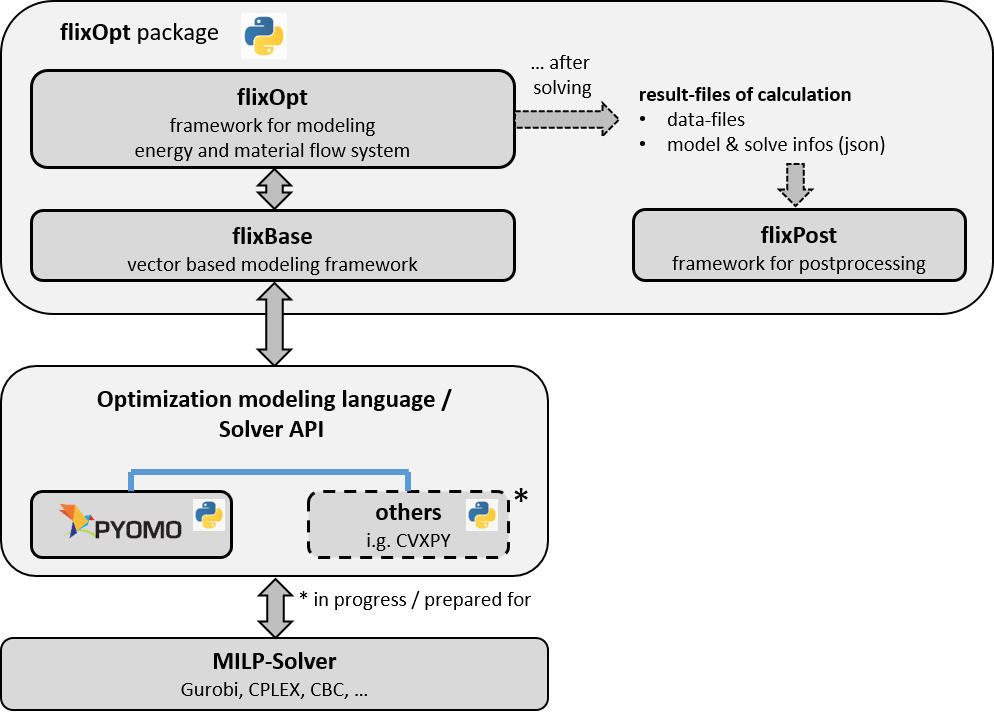
FlixOpt provides a complete workflow for energy system optimization:
- Define your system using Python components
- Optimize with powerful solvers (HiGHS, Gurobi, CPLEX)
- Analyze results with built-in visualization tools
- Export to various formats for further analysis
Community & Support
-
GitHub
Report issues, request features, and contribute to the codebase
-
Discussions
Ask questions and share your projects with the community
-
Contributing
Help improve FlixOpt by contributing code, docs, or examples
Recent Updates
What's New in v3.0.0
Major improvements and breaking changes. Check the Migration Guide for upgrading from v2.x.
📋 See the full Release Notes for detailed version history.
Ready to optimize your energy system?
Basic Installation
Includes the HiGHS solver - you're ready to optimize immediately.
Full Installation
For additional features (interactive network visualization, time series aggregation):
Solver Support
FlixOpt supports many solvers via linopy: HiGHS (included), Gurobi, CPLEX, CBC, GLPK, and more.
🤝 Contributing
FlixOpt thrives on community input. Whether you're fixing bugs, adding components, improving docs, or sharing use cases - we welcome your contributions.
📖 Citation
If FlixOpt supports your research or project, please cite:
- Main Citation: DOI:10.18086/eurosun.2022.04.07
- Short Overview: DOI:10.13140/RG.2.2.14948.24969
To pinpoint which version you used in your work, please reference one of these doi's here: - 